All About Shopping
About Us
Prague Shop
Contact
A Practical Guide for Anyone Who Doesn't Want to Buy Just a Pretty Accessory
The selection of watches today is vast – from models for a few hundred crowns to luxury pieces worth hundreds of thousands. However, price alone is not a guarantee of quality. If you are looking for a watch that will serve you reliably for years (or even a lifetime), it is good to know what to really focus on when choosing.
You don't need to be a watchmaker or a collector. It is enough to know a few basic areas by which the quality of a watch can be recognized relatively easily.
The movement is the most important part of a watch. It determines accuracy, reliability, and lifespan.
Quartz (battery-powered movement)
An ideal choice if you want a maintenance-free watch for everyday wear.
⚠️ Disadvantage: in cheaper models, the movement is often not repaired, but replaced entirely.
Main advantage? Long lifespan and repairability. With regular servicing, mechanical watches can function for decades.
⚠️ Expect: a higher price, the necessity of servicing, and slightly lower accuracy compared to quartz watches.
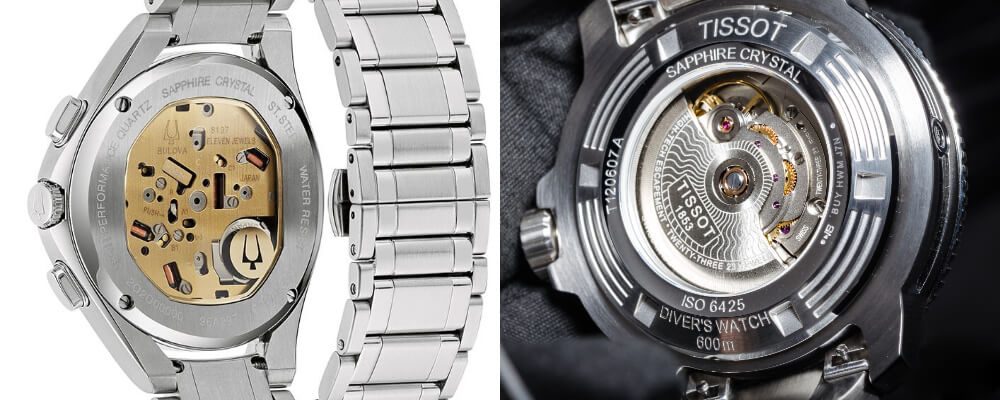
The image shows a quartz movement and a mechanical movement.
You don't need to know every caliber. Just stick to a few principles:
Long-term proven movements include, for example:
You can find these movements in both more affordable watches and models worth tens of thousands – and most watchmakers can service them without any problem.
At first glance, watches may look similar. However, differences in quality reveal themselves during everyday wear.
For metal bracelets, check:
You can recognize quality very well from the dial:
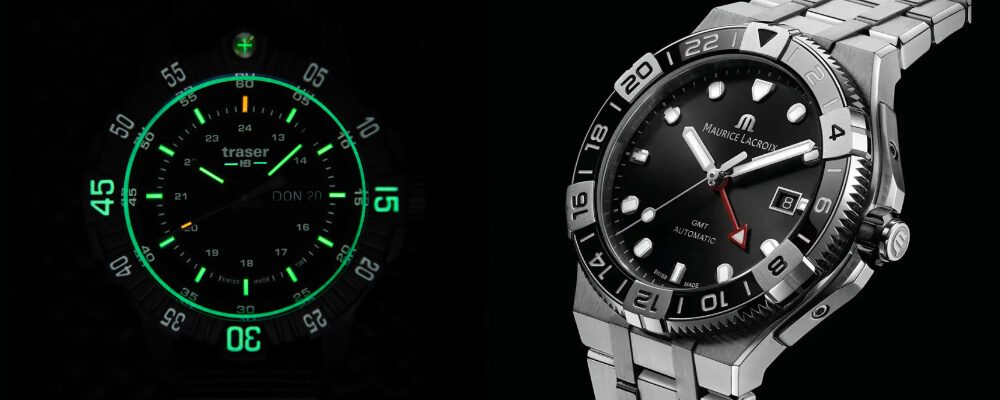
An example of a combination of "standard" luminescence and tritium luminescence, applied indices on the dial.
If you want the watch to look good even after years, sapphire is the clear choice.
Quality watches are not only good-looking but also comfortable. They have well-finished edges and transitions, ergonomically shaped lugs, and a case that doesn't overhang the wrist.
Some models even feature a fully curved case, allowing the watch to fit perfectly even on smaller wrists.
Quality is often indicated by:
💡 Tip: Reviews and experiences of other users are a great helper, but the safest bet is to consult an expert or a specialized store.
Even the technically best watch loses its meaning if it doesn't bring you joy. However, quality means that this joy won't turn into frustration from breakdowns, repairs, or disappointment with durability.
If you know what to focus on, you will choose a watch that:
and will keep entertaining you even after years of wear
And if you are unsure? We will be happy to help you with your selection – from the movement to the clasp.


